 Pamphlet
Recent Activities
Fieldwork Report
2025/12/13
Kaito TANAKA
Graduate School of Science and Engineering,
Fieldwork Report
Global Resource Management and Sustainable
Development Goals 2
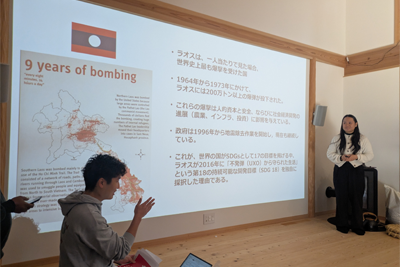
We visited the Keihoku area in northern Kyoto on December 14 to deepen our understanding of the SDGs. There, we experienced shimenawa (sacred rope) making, interacted with members of the local community, and toured the Kyoto Satoyama SDGs Lab “KOTOS.”
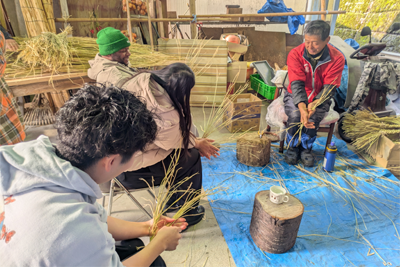
During the shimenawa-making session, we observed community members creating shimenawa to be dedicated to Kasuga Shrine. We were also given the opportunity to try making them ourselves. Until then, I honestly did not understand how shimenawa were connected to the SDGs. However, when I learned that the material—rice straw—is a byproduct of rice cultivation and that something typically discarded can be circulated as a resource, my perspective changed significantly. The practice of using familiar materials without waste aligns with SDG 12, “Responsible Consumption and Production.” Moreover, the way community members cooperated throughout the process and then dedicated the finished shimenawa to the shrine seemed to reinforce local social ties. This relates to SDG 11, “Sustainable Cities and Communities,” as it contributes to preserving local culture and community structures and sustaining regions where people can continue to live. I also learned that rice straw used for shimenawa was once utilized in various everyday tools, such as straw sandals. This helped me understand that rice straw is not merely a sacred material but part of a traditional lifestyle that makes full use of resources obtained from rice farming. Such values— “creatively using what is available and using it for as long as possible”—prompt us to reconsider today’s mass-production, mass-consumption society.
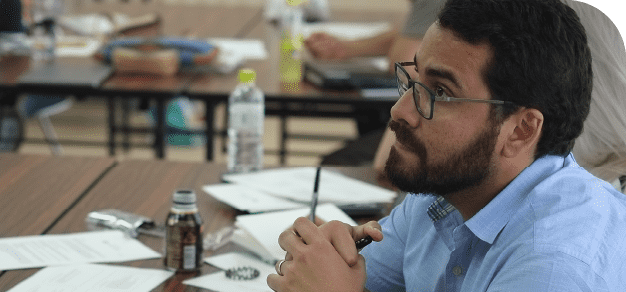
During our interactions with community members, we introduced ourselves and explained our research topics. My research aims to establish a low-environmental-impact production system by creating plastic alternatives made solely from bamboo. The community members were able to hold and examine the actual products. Furthermore, since Kitayama cedar is cultivated in the Keihoku region, we learned that effectively utilizing the wood shavings generated during timber processing would also be beneficial. This experience encouraged me to broaden my perspective on resource circulation—which had previously focused primarily on bamboo—to include unused wood resources as well. I now hope to develop my research further by exploring material designs and molding processes that take advantage of both bamboo and wood.
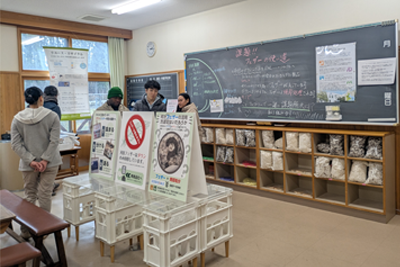
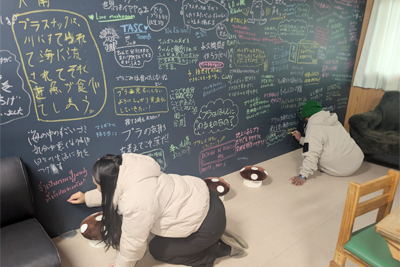
Finally, we visited the Kyoto Satoyama SDGs Lab “KOTOS,” where we observed their activities and exhibits. The displays highlighted how people from diverse backgrounds—business professionals, university faculty, and community members—contribute to addressing regional issues from their respective positions, steadily building up small-scale practical efforts. Through this, I realized that the goal is not simply to “achieve the SDGs” as an end in itself, but rather that the accumulation of ideas and dialogue aimed at improving local living ultimately leads to the attainment of the SDGs. This fieldwork provided a concrete opportunity to consider the importance of giving back my expertise to society in ways that are tangible and meaningful for local communities.
As a researcher in the field of engineering, I aspire not only to develop technologies that enhance user convenience but also to create technologies that support future generations and people in developing countries. To achieve this, I aim to conduct research grounded in the issues and resources found in local contexts, while keeping practical implementation in view.